Dream Interpretation
The Spiritual Meaning of Dreams: How Faith Traditions Read Them
Last updated 2026-10-23 · 10 min read
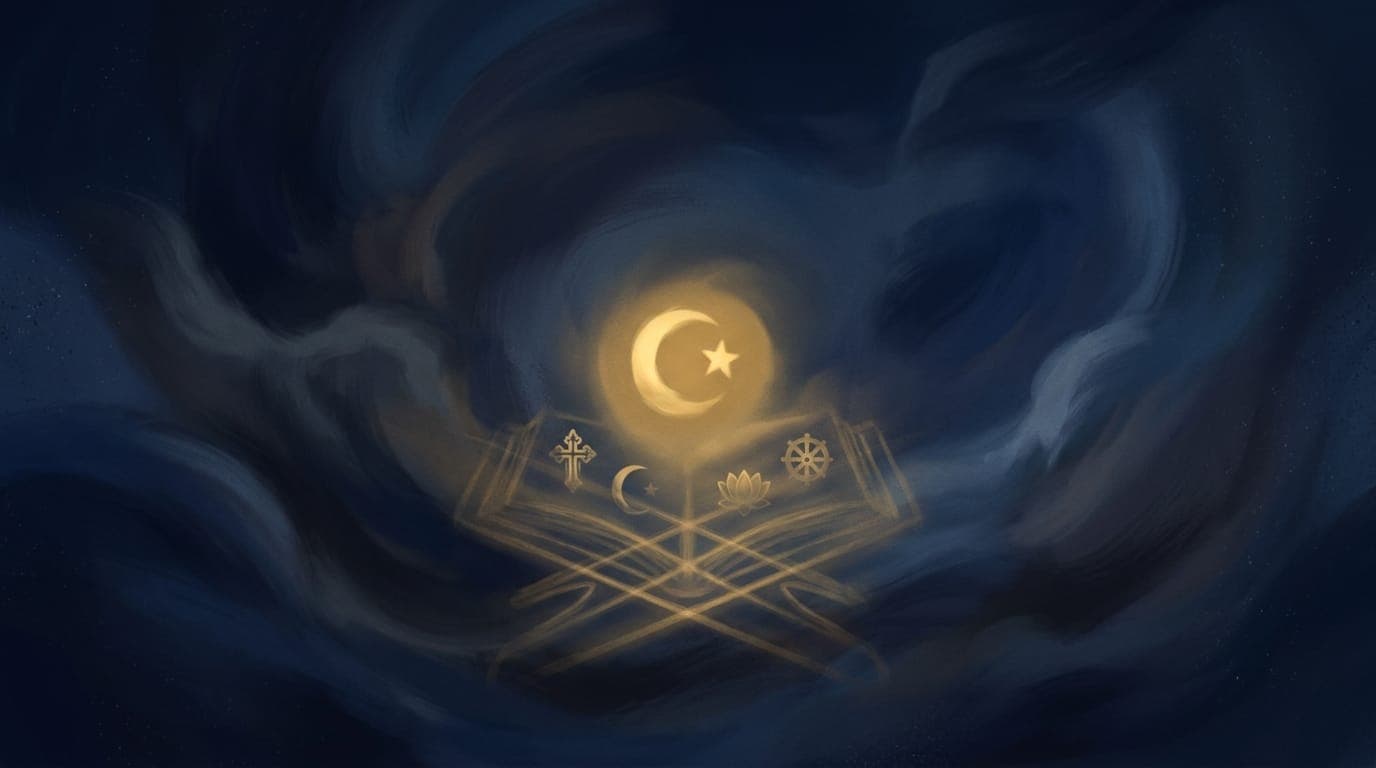
Dreams have carried spiritual weight in nearly every religious tradition on record, from the dream-interpreting prophets of the Hebrew Bible to the dream yoga practiced in Tibetan Buddhist monasteries. People searching for the spiritual meaning of a dream are usually asking one of two questions: what does my faith tradition say about this, or is there something universal going on. This guide looks at both, tradition by tradition, and separates what different religions teach from what sleep science has actually found.
What is the spiritual meaning of dreams?
Across faith traditions, dreams are most often treated as a possible channel for divine or symbolic communication, not as random mental noise. The details vary widely by religion, but the underlying idea, that sleep can open a space where something beyond ordinary waking awareness gets through, shows up again and again.

A 2020 review in Frontiers in Psychology looked at how Hinduism, Buddhism, Judaism, Christianity, Islam, and Spiritism each treat dreaming and related conscious states during sleep. The researchers found real differences in theology and practice, but a shared thread: every tradition they examined gives dreaming some kind of special status, distinct from ordinary waking thought. None of them treat it as spiritually neutral.
That said, "spiritual meaning" is not the same claim in every tradition. A dream read as a message from God in one context might be read as residue from the dreamer's own mind, or as a lesson about the illusory nature of the self, in another. The sections below walk through the major traditions on their own terms.
What does the Bible say about dreams?
The Bible presents dreams as a real but closely guarded channel of communication from God, used with specific people rather than treated as routine. Interpretation, scripture repeatedly says, belongs to God rather than to the dreamer.
Dreams appear across many books of the Bible, and two stories do most of the heavy lifting: Joseph interpreting Pharaoh's dream of seven fat and seven lean cows in Genesis, and Daniel interpreting dreams for Babylonian kings. In both cases, the text is careful to have the interpreter credit God rather than claim personal insight. Joel 2:28, later quoted by Peter in Acts 2:17, describes a future in which old men dream dreams and young men see visions as part of a broader outpouring of the Spirit. Numbers 12:6 puts dreams and visions in a specific place in the hierarchy of revelation: real, but less direct than the way God is described as speaking to Moses.
The Bible is also wary of false dreams. Jeremiah 23:32 condemns prophets who invent dreams and pass them off as messages from God, and Numbers 12 calls the dream-and-vision channel a kind of indirect, riddling speech compared to plain conversation. Modern Christian writers who address the topic tend to land in one of two camps: some argue God can still speak through dreams today and recommend praying for discernment before reading too much into one, while others warn that treating dream symbols like a fixed code, snake always means temptation, water always means emotion, drifts into territory the Bible does not actually support.
How is dream interpretation viewed in Islam?
Islamic tradition treats dreams as a real but carefully sorted category of experience, based on a widely cited hadith that divides dreams into three kinds. A good dream, or ru'ya, is attributed to God. A disturbing dream is attributed to Satan. A third kind simply reflects the dreamer's own thoughts and has no outside source at all.
The distinction between ru'ya and the Arabic word hulm matters in this tradition. One hadith attributed to the Prophet puts it directly: a true vision comes from God, while an ordinary unsettling dream comes from Satan. A separate hadith, recorded in Sahih al-Bukhari, describes a good dream as one part in forty-six of prophethood, which is part of why true dreams are taken seriously without being treated as equivalent to revelation itself. A 2025 study in the academic journal El-Sunan, which focused specifically on the authenticity of the hadith describing good dreams, concluded that the hadith is reliably attested but argued that a true dream should be understood as good news for the individual rather than something with the binding authority of prophecy.
The story of the prophet Yusuf, known as Joseph in the Hebrew Bible, is the central Quranic example of dream interpretation, mirroring the Genesis account in broad strokes. Islamic teaching generally treats interpretation itself as a skill, not something every believer should attempt casually. Classical scholars tied good interpretation to a combination of religious knowledge and the interpreter's own character.
How do Hinduism and Buddhism interpret dreams?
Hindu and Buddhist traditions tend to treat dreaming less as a message from an outside source and more as a state of consciousness worth examining directly. Both traditions have influenced meditation practices built around becoming aware during sleep itself.
Classical Hindu thought, going back more than two thousand years, divides consciousness into three main states: waking, dreaming, and deep dreamless sleep. Some Hindu philosophical schools rank dreaming and deep sleep above ordinary waking awareness, a reversal of the usual Western assumption that waking life is the most "real" state. In this framework, dreams can function as a personal, experiential path toward recognizing that the waking self is also less fixed and solid than it appears.
Buddhism generally reads dreams as a vivid illustration of impermanence and the mind's tendency toward distorted perception, themes that run through Buddhist teaching more broadly. Tibetan Buddhism developed this into an explicit practice known as dream yoga, in which practitioners train to recognize that they are dreaming while still asleep, then use that lucidity to work directly with fear and attachment in a low-stakes setting. Some Buddhist teachers also describe the dreams of advanced practitioners as carrying spiritual significance, though this is treated as a byproduct of practice rather than something to chase for its own sake.
Can dreams be messages or warnings?
Most religious traditions that take dreams seriously also build in a caution: a dream can carry weight, but almost none of them treat every dream as a guaranteed message. The usual advice across traditions is to weigh a dream rather than act on it immediately.
Within Christianity, writers who discuss modern dream experiences commonly suggest paying closer attention to dreams that recur, that carry unusual emotional intensity, or that align with something already unfolding in waking life, while treating a single vivid dream with more caution. Prayer and conversation with trusted, spiritually mature people are the recommended checks, not a dream dictionary used alone. Islamic practice places a similar check on the process by restricting serious interpretation to people with the religious grounding to do it responsibly, specifically because a wrongly confident reading of a dream can mislead the dreamer.
It's worth being direct about dreams involving loss, danger, or death. Across traditions, these get read symbolically far more often than literally: the end of a chapter, a fear that needs attention, a relationship in transition. Don't read a dream about death or a disaster as a literal forecast. No religious or scientific source backs that up, and treating it that way tends to cause unnecessary distress instead of useful insight.
Can dreams predict the future?
There is no good scientific evidence that dreams can predict specific future events, despite how common the feeling of a "predictive" dream is. What explains it, then? Mostly coincidence, plus a memory that's far more selective than it feels in the moment, and a sleeping brain that tends to rehearse whatever is already worrying you.
The Sleep Foundation notes that people tend to remember the rare dream that seems to line up with something real while forgetting the much larger number of dreams that led nowhere, which creates an illusion of accuracy that does not hold up when dreams are tracked systematically rather than recalled after the fact. A psychologist's explanation sometimes offered for dreams that do seem to anticipate real events is that the sleeping brain is quietly processing information you already have, consciously or not, and producing an educated guess rather than genuine foresight. Someone anxious about a relationship, for instance, might dream of a breakup weeks before it happens, not because the dream foresaw it, but because the underlying tension was already there to notice.
None of this is meant to dismiss why a predictive-feeling dream can be unsettling, especially when it touches on something serious. It is meant to separate two different claims: that a dream can feel emotionally significant and worth reflecting on, which is well supported, and that a dream can reliably forecast a specific future event, which is not.
What are the different types of dreams in spiritual traditions?
Religious and dream-studies scholars generally sort spiritually significant dreams into a few recurring categories: message or revelatory dreams, symbolic dreams that require interpretation, and dreams connected to a lucid or meditative practice. Ordinary dreams, by contrast, are treated in most traditions as everyday mental activity rather than something with special weight.
Revelatory dreams are the clearest case, a dream experienced as a direct communication, as with the biblical and Quranic Joseph narratives. Symbolic dreams are more common and require someone, often a trained interpreter within the tradition, to work out what the images might mean rather than taking them literally. Lucid dreaming occupies a different category altogether in traditions like Tibetan Buddhism, where it is cultivated deliberately as a meditative skill rather than something that simply happens to a person. Outside the major world religions, traditions like historical Zulu practice describe healers receiving their calling through dreams treated as both prophetic and diagnostic, a reminder that this pattern, dreaming as a channel for meaningful knowledge, is not limited to the handful of traditions most commonly discussed in English-language sources.
How can I interpret my dreams spiritually?
Start with the framework your own tradition actually uses rather than a generic symbol dictionary, and pay attention to the dream's emotional tone alongside its content. Across traditions, context and reflection consistently matter more than any single symbol.
A workable approach looks something like this. First, write the dream down while it is fresh, since detail fades within minutes. Second, ask what in your current life the dream might be echoing, a worry, a decision, a relationship, rather than assuming it points outside your own circumstances entirely. Third, bring it to whatever your tradition treats as a source of discernment, prayer, meditation, scripture, or a trusted teacher, rather than settling the question alone in the moment. Finally, hold the interpretation loosely. Even traditions that take dreams seriously generally agree that certainty about a dream's meaning is rare, and that the value is usually in the reflection a dream prompts rather than in a single, fixed answer.
If a dream is distressing rather than simply puzzling, especially one involving death, harm, or disaster, treat it as a signal to examine what is weighing on you emotionally, not as a prediction to brace for. That framing holds up across both the religious traditions and the sleep science covered here.
Sources
- Frontiers in Psychology: The Dream of God: How Do Religion and Science See Lucid Dreaming and Other Conscious States During Sleep?
- Sleep Foundation: Precognitive Dreams: Can Dreams Predict the Future?
- El-Sunan Journal: True Dreams in Hadith: An Authenticity Critique and Its Implications for Islamic Spirituality
- Bible Gateway: Joel 2:28
- Britannica: Dreams as a Source of Divination
Related reading: see what it means to dream about god, dream about ghosts, or dream about someone dying for symbol-specific entries, or browse the full dream dictionary. For the science side of dreaming, read why do we dream.