Dream Science
Sleep Paralysis: What It Is, Why the Visions Feel Real, and How to Stop It
Last updated 2026-10-30 · 11 min read
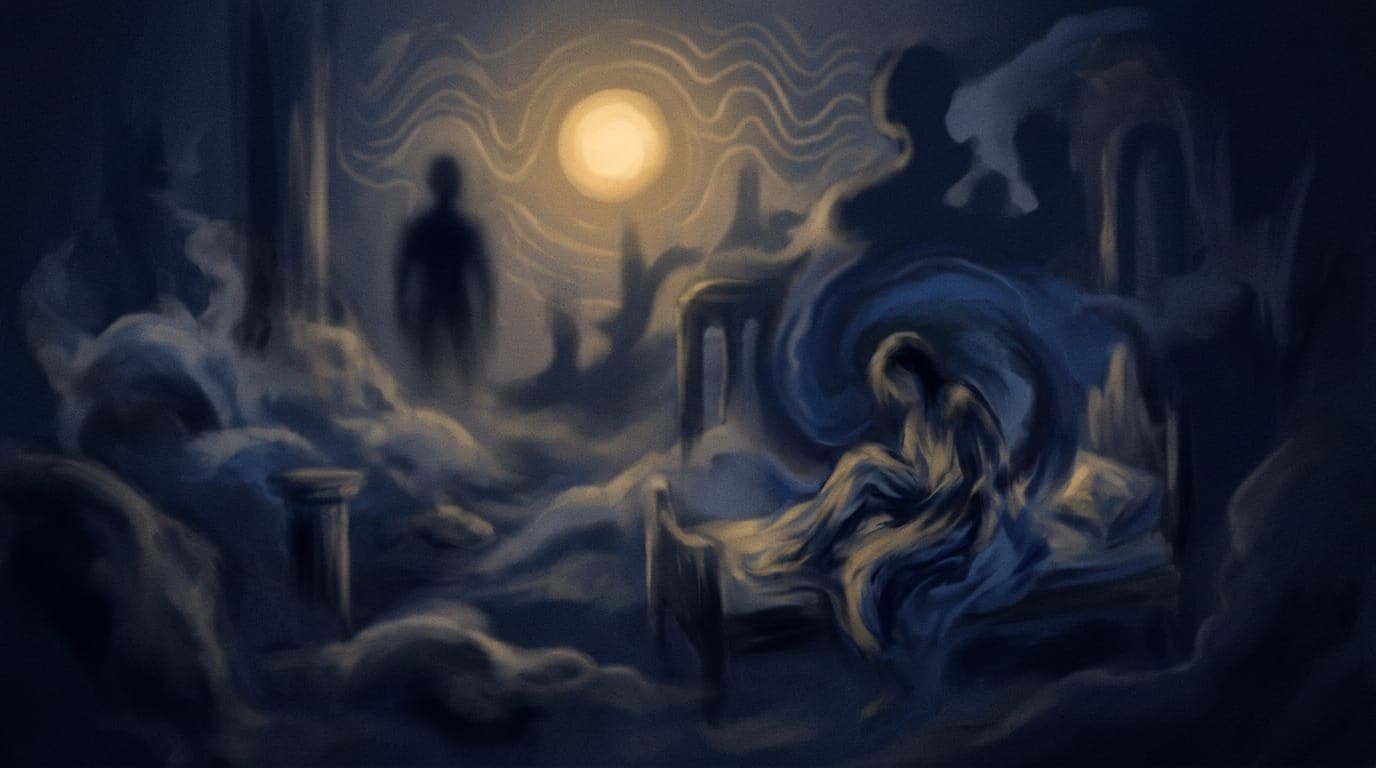
You're awake. You know you're awake, because you can see your room, your ceiling, the shape of the doorway. But you can't move, can't speak, and something in the room feels wrong, sometimes someone, sitting at the edge of the bed or pressing down on your chest. Then, seconds or minutes later, it's over, and you can move again like nothing happened.
That experience has a name, sleep paralysis, and it's far more ordinary, neurologically, than it feels in the moment. It's also one of the few sleep phenomena with a documented paper trail stretching back centuries, since people in wildly different cultures have been describing the same chest pressure and the same lurking figure for as long as anyone's been writing things down.
What causes sleep paralysis?
Sleep paralysis happens when your mind wakes up before your body does. REM sleep normally shuts off most of your voluntary muscles, a state called REM atonia, so you can't physically act out whatever you're dreaming. Sleep paralysis is that same shutdown persisting for a few seconds or minutes after conscious awareness has already returned.
The mismatch is the whole mechanism. Falling asleep and waking up aren't single-moment switches, they're staged transitions through different sleep stages, and REM atonia is supposed to clear in step with the rest of that transition. When it doesn't, you end up fully conscious, fully able to see and hear your surroundings, and fully unable to move anything except your eyes. The episode ends on its own once the nervous system finishes catching up, and most last well under a few minutes even though they rarely feel that short.
Irregular sleep schedules, sleep deprivation, and sleeping on your back all show up consistently across sleep paralysis research as factors that make an episode more likely, according to a 2024 review in the journal Cureus covering the condition's mechanisms and management. Narcolepsy is the sleep disorder most strongly linked to frequent episodes, since the same disrupted REM regulation that causes narcolepsy's other symptoms also makes the boundary between REM sleep and wakefulness easier to cross at the wrong moment. Stress and anxiety are repeatedly associated with recurrence too, which is part of why episodes often cluster during a genuinely rough stretch of life rather than showing up at random.
Why do people see a figure or demon during sleep paralysis?
Researchers link the sensed presence, and the shadow figures, pressure, and whispered threats that often come with it, to a hypervigilant brain state created when REM-stage imagery and emotion bleed into waking consciousness. The brain's threat-detection circuitry stays active while the rest of it is still half in dream mode, and it interprets the ambiguous, frightening mix as an intruder.

A 1999 paper in Consciousness and Cognition by psychologist J. Allan Cheyne and colleagues, which examined hundreds of first-person sleep paralysis accounts, proposed that this cluster of symptoms, a sensed presence, fear, and both visual and auditory hallucinations, forms a single coherent experience rooted in a hyperactive midbrain threat response rather than several unrelated glitches. The paper's title calls this phenomenon the construction of the "night-mare", using the old English sense of the word, a demonic visitor sitting on a sleeper's chest, which predates the modern meaning of "bad dream" by centuries and describes sleep paralysis far more literally than it describes an ordinary nightmare.
The chest-pressure sensation has a mundane explanation too. During REM atonia, breathing shifts to a shallower, more irregular pattern controlled almost entirely by the diaphragm, and that altered breathing can itself feel like weight or pressure on the chest once awareness returns and the brain starts looking for an explanation. Combine that physical sensation with a threat-primed, half-dreaming brain, and a shape in the corner of the room stops being an unusual leap.
Is sleep paralysis dangerous?
No. An isolated episode of sleep paralysis is not physically harmful, no matter how frightening it feels while it's happening. Cleveland Clinic notes that you can safely wake someone during an episode by touching or talking to them, and doing so typically ends it faster rather than causing any harm.
Where it's worth paying attention is frequency and company. Sleep paralysis that happens often, especially alongside excessive daytime sleepiness, sudden muscle weakness triggered by strong emotion, or vivid dream-like experiences right at sleep onset, can point toward narcolepsy and is worth raising with a doctor. The same goes for episodes that start causing real anxiety about going to sleep, since that avoidance pattern can become its own sleep problem independent of the paralysis itself. Outside of those warning signs, an occasional episode is closer to a sleep hiccup than a medical event.
How common is occasional sleep paralysis, exactly? A systematic review published in Sleep Medicine Reviews, which pooled 35 studies and more than 36,000 participants, found a lifetime prevalence of 7.6 percent in the general population, rising to 28.3 percent among students and 31.9 percent among psychiatric patients. That spread lines up with what the risk factors above would predict: irregular schedules and higher baseline stress are both more common in student and clinical populations than in the general public.
How do you stop sleep paralysis in the moment?
There's no instant way to end an episode, but focusing on small, deliberate movements, wiggling one finger, then a toe, rather than straining to move your whole body at once, tends to break the paralysis sooner than fighting it outright. Cleveland Clinic specifically notes that people often come out of an episode faster once they manage even one small, successful movement.
Slow, steady breathing helps too, mostly by keeping panic from making the experience feel longer than it is. A few things make episodes worse in the moment: thrashing against the full-body paralysis, which rarely works and tends to spike the fear response, and assuming the presence in the room is something you need to fight rather than a hallucination your brain is actively generating. Some people find the opposite approach, consciously relaxing back into the paralysis instead of straining against it, shortens the episode just as effectively, since panic itself seems to be a bigger driver of how long an episode feels than the paralysis mechanism does.
None of this prevents the next episode. For that, the same list that shows up across the research keeps recurring: a consistent sleep schedule, enough total sleep, side or stomach sleeping instead of flat on your back, and lower baseline stress. Frequent episodes that don't respond to those changes are a reasonable thing to bring to a doctor, since treatable conditions like sleep apnea or narcolepsy sometimes sit underneath them.
Is sleep paralysis connected to lucid dreaming?
Yes. Both experiences involve awareness surfacing while the brain is still partly in REM sleep, which is why people who practice lucid dreaming techniques often become familiar with sleep paralysis sensations well before anyone mentions the connection to them directly.
Wake-induced lucid dreaming, one of the more advanced induction methods lucid dreamers use, works by staying consciously aware while the body completes its normal transition into REM sleep, which means deliberately passing through something very close to a sleep paralysis state on the way into the dream. Practitioners of this technique generally report that the paralysis itself becomes a neutral or even useful signal once it's expected, rather than the frightening surprise it is for someone experiencing it cold. That reframing, from unexpected threat to familiar transition, appears to be the single biggest factor in how distressing an episode feels, more so than anything about the paralysis mechanism itself. If you want to build the broader skill set this connects to, our beginner's guide to lucid dreaming covers the gentler, lower-intensity techniques most people start with instead.
This overlap also explains why sleep paralysis and nightmares get confused for each other even though they're mechanically distinct. A nightmare is a disturbing dream you wake up from with intact memory of a narrative; sleep paralysis is a waking, conscious experience with no story at all, just a frozen body and a hallucinated presence layered on top of real surroundings. The confusion between the two is common enough that it's worth being precise about which one you're actually describing before searching for a fix.
Can sleep position make sleep paralysis worse?
Sleeping on your back is one of the more consistently reported risk factors in sleep paralysis research, repeatedly linked to higher episode frequency compared to side or stomach sleeping. The mechanism isn't fully settled, but it may relate to how supine sleep affects breathing patterns and arousal thresholds during REM sleep.
It's a small, practical lever compared to sleep schedule or stress, but it's also one of the easiest to actually change. People who notice a pattern of episodes after sleeping on their back sometimes see a real reduction just from switching sides, without touching anything else about their routine. It's not a guaranteed fix on its own, since irregular sleep and sleep deprivation tend to matter more, but it's a reasonable first adjustment precisely because it costs nothing and requires no appointment.
Why does nearly every culture have a name for this?
Because the underlying brain state is universal, cultures that never had contact with each other independently described the same experience in almost identical terms: pressure on the chest, an inability to move, and a malevolent presence in the room. The details of who or what that presence is supposed to be change by region; the symptom cluster underneath it doesn't.
Newfoundland's "Old Hag" is probably the best-documented example, thanks to folklorist David Hufford's research at Memorial University, which found that people who had never heard the local Old Hag legend still described the exact same experience when asked about unusual nighttime episodes, right down to the chest pressure and sensed presence. Records of the belief in Newfoundland date back to at least the 1890s. Japan has its own term, kanashibari, literally "bound in metal," historically blamed on fox spirits or wandering ghosts depending on the era. Western folklore's incubus and succubus legends describe the same chest-crushing nighttime visitor in a different costume. None of these traditions were comparing notes; they were all independently naming the same neurological event because it's common enough, and distinctive enough, to demand an explanation in every culture that experiences it.
This is also why sleep paralysis researchers increasingly build cross-cultural measurement tools rather than assuming findings from one population generalize everywhere. A validated instrument called the Unusual Sleep Experiences Questionnaire was specifically developed to let researchers compare sleep paralysis experiences across different cultural and linguistic groups without the comparison breaking down over translation or local framing. The fact that this kind of tool is even necessary says something: the core experience travels across cultures intact, but the fear response and the stories built around it clearly don't travel the same way.
Knowing the folklore doesn't make an episode less startling in the moment, but it does mean you're dealing with one of the most consistently documented, culturally universal sleep phenomena there is, not something unique to you or your particular dreams. For symbol-specific breakdowns of fear-driven dream content, including the overlap between sleep paralysis hallucinations and classic nightmare imagery, see our entries on dreaming about ghosts and dreaming about being chased, or browse the full dream dictionary for more.
Sources
- Cleveland Clinic: Sleep Paralysis
- Sharpless, B.A. & Barber, J.P., "Lifetime prevalence rates of sleep paralysis: a systematic review," Sleep Medicine Reviews
- Cheyne, J.A., Rueffer, S.D. & Newby-Clark, I.R., "Hypnagogic and hypnopompic hallucinations during sleep paralysis: neurological and cultural construction of the night-mare," Consciousness and Cognition, PubMed
- Bhalerao, V. et al., "Recent Insights Into Sleep Paralysis: Mechanisms and Management," Cureus, PMC
- Paradis, C. et al., "The Assessment of the Phenomenology of Sleep Paralysis: The Unusual Sleep Experiences Questionnaire (USEQ)," PMC
- NHS: Narcolepsy - Symptoms