Dream Interpretation
The 20 Most Common Dreams and What They Mean
Last updated 2026-10-16 · 11 min read
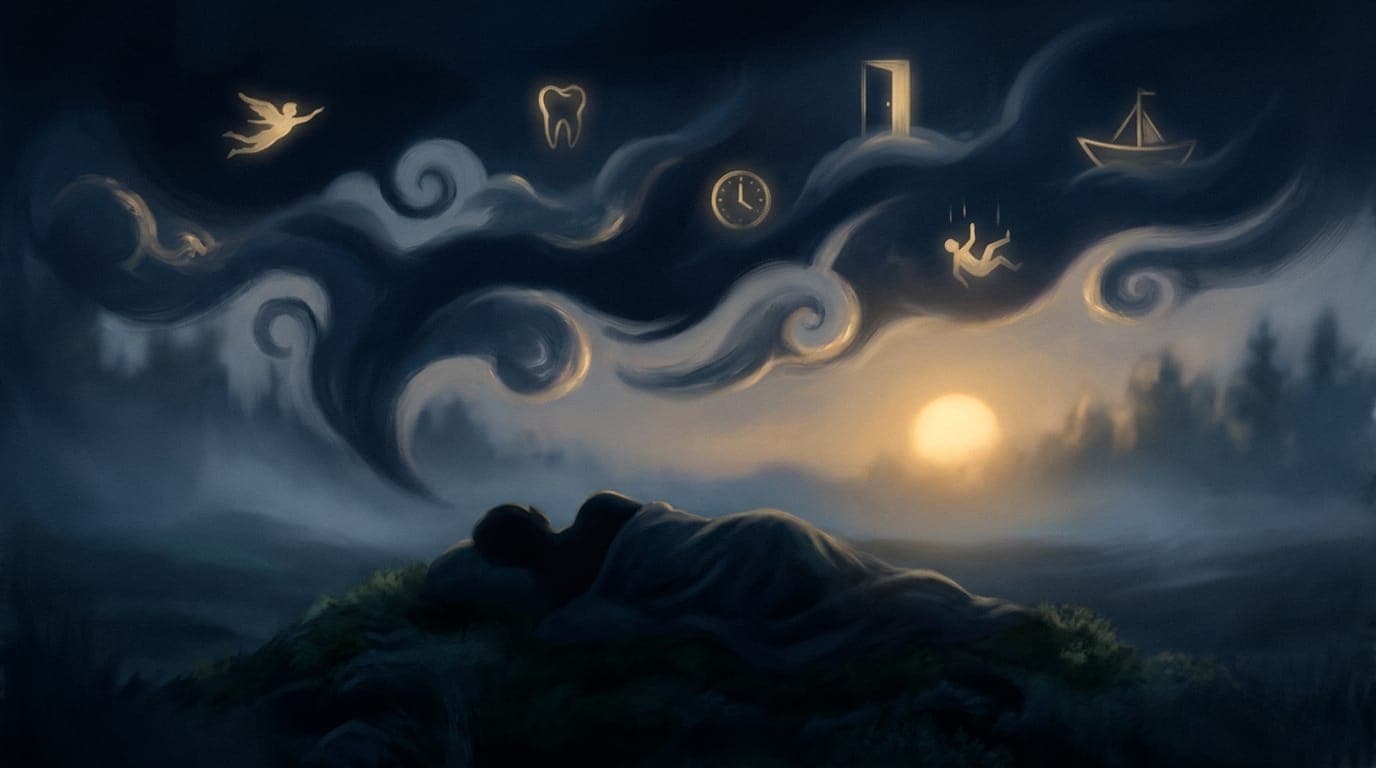
Ask ten people what they dream about and you will hear the same handful of scenarios over and over: falling, showing up somewhere without clothes, losing teeth, being chased by something that never quite catches up. That repetition is not a coincidence. Decades of dream-content research, going back to the Hall and Van de Castle norms of the 1960s through more recent survey work, keep turning up the same core set of themes across different countries, age groups, and decades. This list pulls together the dreams that research and large-scale surveys actually back up, what each one tends to mean, and links to a full breakdown for each symbol.
How Was This List of Common Dreams Put Together?
This list combines large-scale survey data with peer-reviewed dream-content research, rather than relying on anecdote or a single poll. Each of the 20 dreams below shows up independently in more than one source.
Three kinds of evidence went into the ranking. The first is academic dream-content analysis, including the Hall and Van de Castle norms built from roughly 1,000 American college-student dream reports collected between 1947 and 1950, and Calvin Yu's 2008 replication of that same methodology with Hong Kong university students. The second is clinical nightmare research, including a 2014 content analysis of nearly 700 nightmares and bad dreams logged by adult volunteers. The third is large consumer survey data, like Amerisleep's 2,000-person survey of recurring dreams, which is useful for gauging how common a theme feels to ordinary dreamers even though it was not run under laboratory conditions. Themes that only showed up in one of these three sources did not make the cut; everything below appears in at least two.
What Is the Most Common Dream People Have?
Falling is the single most commonly reported dream in large surveys. A 2,000-person Amerisleep survey found 53.5 percent of respondents had dreamed about falling, just ahead of being chased at 50.9 percent. Academic dream-content studies back this up too: Hong Kong researcher Calvin Yu's 2008 survey of nearly 350 university students found falling and being chased among the most frequently recurring themes, matching patterns already documented in earlier Western research.
Falling dreams cluster around periods when something in your life feels unsteady, like a job change, a relationship under strain, or a decision you are not sure you made correctly. See the full dream about falling breakdown for scenario-specific detail.
What Are the Top 10 Most Common Dreams?
The ten most consistently reported dreams, across both survey data and academic dream-content research, are falling, being chased, teeth falling out, flying, being naked in public, being late, snakes, being lost, cheating, and someone dying. Each shows up independently across multiple studies rather than just one source.

Here is what each one tends to point to:
- Falling - a sense that something in your life is slipping out of your control. It is also one of the few dream themes people reliably report waking up from with a physical jolt, since the muscle twitch that sometimes accompanies the dream, called a hypnic jerk, happens as the body drifts into deeper sleep.
- Being chased - an unresolved stressor or conflict you have been avoiding rather than confronting directly. What is chasing you matters less than how the dream ends; dreams where you escape or turn to face the pursuer tend to coincide with periods when the dreamer feels more in control of the underlying issue.
- Teeth falling out - commonly tied to anxiety about appearance, aging, or losing control over how others see you, though a 2018 study of 210 undergraduates found these dreams correlated more strongly with dental irritation felt on waking than with psychological distress.
- Flying - usually a positive dream, associated with confidence or a sense of freedom from a constraint in waking life. Dreamers who report frequent flying dreams often describe a recent win, promotion, or decision that lifted a long-standing weight.
- Being naked in public - a fear of being exposed, judged, or caught unprepared in front of others. The specific setting usually points to where that fear is centered, whether that is work, school, or a social group.
- Being late - performance pressure or a worry about falling short of an obligation. This theme spikes noticeably around deadlines, exams, and big life events like weddings or job starts.
- Snakes - one of the most-searched dream topics worldwide. Meaning shifts heavily by context, from threat to transformation, depending on whether the snake is attacking, shedding its skin, or simply present in the scene.
- Being lost - uncertainty about direction in waking life, often during a transition like a new job or a move. The specific place you are lost in, a familiar city versus somewhere unrecognizable, tends to track how disoriented the underlying situation actually feels.
- Cheating - more often about trust or insecurity in a relationship than a literal prediction of infidelity. Search-trend data ranks it among the most-searched dream topics worldwide, which suggests a lot of people wake up from one looking for reassurance rather than evidence.
- Someone dying - frequently tied to grief processing or fear of change, not a predictive warning. Dreaming about a living person dying is especially common during a period when that relationship is changing in some way, not necessarily ending.
What Are the Next 10 Most Common Dreams and What Do They Mean?
Rounding out the 20 most commonly reported dreams are an ex-partner, pregnancy, water, spiders, zombies, a car crash, being arrested, your childhood house, money, and ghosts. These show up less universally than the top 10 but still recur often enough across surveys and dream forums to count as genuinely common rather than niche.
- An ex - usually about an unresolved feeling the relationship left behind, not a sign you should reconnect. The dream tends to recur most during a new relationship, not right after the breakup, as the brain compares the new situation to the old one.
- Pregnancy - often linked to a new project, idea, or change developing in your life, for dreamers of any gender. The emotional tone of the dream, excited versus anxious, usually tracks how the dreamer feels about that change far more than the pregnancy content itself.
- Water - one of dream research's oldest symbols, generally tracking emotional state. Calm water tends to mirror calm, while turbulent or rising water tends to mirror stress, and the clarity of the water often tracks how clear or confusing the underlying feeling is.
- Spiders - commonly tied to a feeling of being entangled in a situation, or a specific person who feels threatening. The size and behavior of the spider in the dream usually scales with how large that feeling of entanglement currently feels.
- Zombies - frequently connects to burnout or feeling like you are going through the motions without real engagement, whether that is at work, in a relationship, or in a daily routine that has gone stale.
- A car crash - a documented nightmare theme. A 2014 analysis of nearly 700 nightmares and bad dreams found physical danger and failure themes like this one among the most common content categories recorded.
- Being arrested - usually a feeling of being restricted, blamed, or held accountable for something, rather than guilt over an actual crime. It shows up often during disputes with authority figures, from a manager to a parent.
- Your childhood house - tied to memory and identity. A childhood home often surfaces during periods of major life change, as if the brain is reaching back for a reference point for what safety or stability used to feel like.
- Money - tracks a sense of security or control more than it tracks your actual finances. Finding money in a dream often lines up with a recent win or a sense of relief, while losing it tends to show up during a stretch of real-world uncertainty.
- Ghosts - often connects to something from the past, a memory or unfinished business, that has not fully been let go. A specific ghost who resembles someone you knew usually points to something unresolved with that relationship rather than anything supernatural.
What Do the Most Common Dreams Actually Mean?
Most common dreams reflect an active emotional concern rather than a literal message or prediction. Dream researchers generally reject the idea that any symbol has one fixed meaning, in favor of a model where the same image draws on whatever memory or feeling is active for that person right now.
That is part of why falling shows up so reliably across different people's lives: the feeling it represents, a sense that something is slipping out of your grip, is a near-universal human experience, even though the specific thing slipping differs completely from person to person. The Cleveland Clinic's overview of dreaming notes that stress and anxiety reliably increase both the frequency and the intensity of dreams and nightmares, which lines up with why these same themes spike during exam periods, job transitions, or relationship strain rather than showing up at random.
Why Do So Many People Have the Same Dreams?
So many people report the same dreams because the underlying fears and experiences those dreams draw from are close to universal. Falling, being chased, and losing control over your body or appearance are experiences nearly everyone can recognize, which is why the same handful of themes keeps surfacing across different countries, decades, and age groups.
The original Hall and Van de Castle research, drawn from roughly 1,000 dream reports collected from American college students between 1947 and 1950, found negative emotions present in 80 percent of dreams and an aggression-to-friendliness ratio tilted heavily toward aggression. Yu's 2008 replication with Hong Kong university students found a strikingly similar pattern decades later and in a completely different culture, which is the strongest evidence that these themes are tied to broad features of human experience rather than one specific time or place. One leading theory, threat simulation, argues that dreaming lets the brain rehearse dangerous or threatening scenarios in a low-stakes setting, which would explain why chase and danger themes are so consistently among the most common dreams on record.
What Is the Rarest Dream to Have?
Lucid dreams, where you become aware you are dreaming while it is still happening, are among the rarest dream experiences people report, along with so-called mutual or shared dreams. A lucid dream involves a partial reactivation of the prefrontal cortex during REM sleep, the brain region that usually goes quiet during dreaming, which is part of why lucid dreamers describe a strange mix of dream logic and real-world self-awareness happening at once.
Mutual dreaming, where two people believe they shared the identical dream, is reported anecdotally but has no scientific evidence behind it. What usually happens instead is that two people who went through the same event, like a breakup or a funeral, each have a separate dream shaped by that shared experience, then compare notes afterward and remember the overlap as closer than it actually was.
Should You Worry If You Keep Having One of These Dreams?
An occasional version of any dream on this list is not a cause for concern. These themes show up in most people's dream life at some point precisely because they are common, not because something is wrong.
A pattern worth paying attention to is frequency and distress, not content. If the same dream, chasing, falling, or losing someone, keeps recurring for weeks and disrupts your sleep or your mood the next day, that usually points to an unresolved stressor worth addressing directly rather than a dream that needs decoding. Our guide to recurring dreams covers a clinically studied technique for changing a dream that keeps repeating, and our guide on why we dream covers the broader science behind why dream content tracks emotional state as closely as it does. If the dream is specifically distressing rather than merely frequent, our guide to nightmares covers when that crosses into something worth discussing with a doctor.
Sources
- Sleep Foundation: Dream Interpretation
- Cleveland Clinic: Dreams and Dreaming
- Robert, G. & Zadra, A. "Thematic and Content Analysis of Idiopathic Nightmares and Bad Dreams," Sleep 37(2):409-417 (2014), PubMed Central
- Yu, C.K.C. "Typical Dreams Experienced by Chinese People," Dreaming 18(1):1-10 (2008), American Psychological Association
- Psychology Today: The 11 Most Common Subjects of Our Nightmares